Monday, June 30, 2008

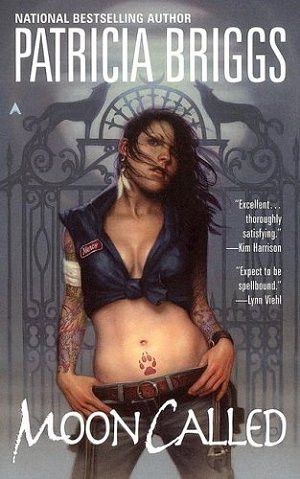
Moon Called


On the strength of Charles de Lint's reviews of these books in his "Books to Look for" column in FANTASY & SCIENCE FICTION, I finally decided to read Patricia Briggs' MOON CALLED. This is the first in her series starring Mercedes "Mercy" Thompson, an auto mechanic and shape-shifter.
As per most urban fantasy novels, the action centers around werewolves, vampires, and other assorted magical creatures and their attempts to exist within the "real" world. There are the usual power struggles and ancient orders of mystical beings. But what Briggs brings to the table is a vivid writing style and a clean storyline. Her explanations are not too convoluted and her characters are interesting enough to want to follow. All in all, it is a fun book and a delight to read. I'll be getting more of these from my local library.
If I had any complaint, it would be more on the genre than this particular book. That complaint is the need for nubile, young, tattooed and scantily clad women to grace the covers. Not that I am against any of that mind you, but outside of a small mention of one tattoo, this image never plays a role in the book. And not that a cover needs to completely reflect the contents, but these soft-core images could help to put down an emerging genre as being what the covers do depict.

Labels: , , , ,

Wednesday, June 25, 2008

Nothing to Lose


Lee Child's Jack Reacher novels are like comfortable shoes these days. You know exactly what you are going to get from them and you don't mind at all. By this time, the Reacher plot is formulaic. Reacher hitchhikes to town, discovers something that aggravates his sense of the world, meets a girl, knocks some heads, fights out of a bad situation, defeats the bad guys, and walks away. And that is exactly how this book goes as well. Not that I minded because that is what Child's readers are looking for. Just as with Clive Cussler's Dirk Pitt, I wanted a fun adventure without the need to plumb the language for hidden meaning.

My only complaint is that the UK cover is so much better than the US version. For once in a Reacher book, guns are almost never used. Thus the imagery (while keeping in line with the style started with Persuader) is completely wrong for the book. But then again, many series books keep the same look to maintain links through the series. But some do it better than others. The first half of the Grafton alphabet had nice paintings or images that dealt with the story. Now they have the same boring look with only the color on the fonts to really differentiate them. Childs' last few are all variations on the bulls eye with different colors and the occasional bullet hole. Rather dull if you ask me. At least the UK covers convey a sense of the action and the art looks nice.

Time to move on to another book.

Labels: , , ,

Wednesday, June 18, 2008

Bad Moon Rising


Wow, talk about a middle finger to your readers. Mr Maberry starts out BAD MOON RISING with a note to the readers that they could read this novel without having read the previous two. While I am a firm believer of authors bringing readers back up to speed on a series that took a year between books and a firm believer that any reader should be able to pick up a book without having to read previous installments, to announce that it was not necessary to have read the past two books made me ask, "Then why write them?" Readers of the previous two books could not have passed on the third novel because of their distinct lack of conclusion, and neither of those books stand on their own. Yes, this is the concluding novel, but don't tell everyone who invested time in the earlier fragments that their efforts were unnecessary. (For a better stand-alone trilogy, see John Scalzi's OLD MAN'S WAR, THE GHOST BRIGADES, and THE LAST COLONY)
Again, Maberry writes a fast-paced book that moves along smartly. However, he telegraphs his blows a little too easily. Everyone I thought would be a victim died with one exception from earlier books and two exceptions from this book. A couple of concepts were introduced and immediately highlighted how certain elements of the story would progress. Also some key details were dropped or lightly alluded to or never fully developed (I'm specifically talking about the dime, but there were other moments (key deaths and plot developments) - if you are going to continually refer to something, you should use it in something other than a throwaway moment.)
My major complaint was the stupidity of the characters and their incessant delays. Saul spent the entire second book moaning about what he knew and how he needed to talk to someone about it. No one could figure out that Griswold's buddies were actually bad guys until the action happens. The characters know they are sitting on a powder keg and yet they do nothing to stop the big festival. And so on. I said it before and I'll say it again - Stephen King did this same story in a third of the length with a ton more drama and horror. I cannot think of a single thing in these books that scared or disturbed me and it was almost more like a thriller with vampires.
The other element that could have been edited out were the celebrity cameos. Did we really need to see Tom Savini and Brinke Stevens fending off vampire hordes? It was cute, but unnecessary to the story.
Finally, the author in his end notes states that people ask if he will bring the characters back. I would hope not. Their story is played out and to do more would add nothing. These are not bad books, but there are better horror novels to read.

Labels: , , , ,

Friday, June 13, 2008

Dead Man's Song


Jonathan Maberry's GHOST ROAD BLUES was the first book I ever wanted to fling across the room when I finished it. Just as I was lamenting with THE SIX SACRED STONES, GHOST ROAD BLUES was the unlabeled first book of a trilogy. While it was an interesting read, it just ended with no resolution. Had I known it was a trilogy, I never would have started the series. My general rule of thumb is to read a series as a whole because I prefer to get the whole story. This is the main reason I have not read Jack Campbell's Lost Fleet series yet (two more books to be published). The one saving grace to this trilogy was that I did not buy the book - thank you public library. But I swore that I would not finish the series (if I finished it), before the rest of the books were out. The last book BAD MOON RISING is now on the shelves.

So, I looked up DEAD MAN'S SONG in the library catalog and there it was. As with GRB, it flows smoothly and moves quickly, but again nothing was resolved and the plot crept forward a couple of inches. Essentially, Maberry is rehashing SALEM'S LOT in three 500-page chunks. Stephen King managed to tell the same story in one.

So now it comes down to the last book, BAD MOON RISING to explain all that happened and to actually complete the story. DEAD MAN'S SONG changed nothing other than killing off a few more minor characters. None of our leads are dead, the evil is still hidden, and the atmosphere hangs heavy.

While Mr. Marberry tells a nice story, this could have been whittled down. This book consisted mostly of Mike Sweeney's chrysalis, Terry Wolfe's nightmares, and Saul Weinstock saying, "We need to talk, but not now." This last one is particularly grating because the book takes place over the course of two weeks and they still couldn't find time to talk even a little bit?

I'll reserve judgment until I read the final installment, but I have a good picture of where this is going, who will survive (readers already know one if they read this book), and how the final chips will fall.

Maberry won the Bram Stoker Award for best first novel for GRB. I hope the series is deserving.

Labels: , , , ,

Thursday, June 12, 2008

Strip for Murder

I don't know a better way to say this, but I believe Max Allan Collins is the best mystery author on the planet and is in a three-way tie for best author with Harlan Ellison and Joe R. Lansdale.

Collins writes hard-boiled mysteries in a Spillane-style and yet never overplays the mood. It is easy for hard-boiled to quickly turn into self-parody, but Collins deftly avoids this trap. However, this does not mean that he lacks a sense of humor. STRIP FOR MURDER and its predecessor A KILLING IN COMICS are great fun. Our heroes - Jack and Maggie Starr - are the owners of the Starr Syndicate, a lesser newspaper distribution service like King Features and United Media. Jack is the former playboy son of the founder who is now a vice-president of the company and chief troubleshooter. Maggie is Jack's stepmother, president of the company and a former stripper. Together they work to protect their business interests and solve a crime or two in the process.

In this story, Jack and Maggie are embroiled in the public feud between Hall Rapp and Sam Fizer, creators of the comic strips Tall Paul and Mug O'Malley respectively. One night Sam turns up dead and Jack and Maggie must figure out why.

Unlike the Nathan Heller series which focuses on real-life crimes in a fictional way, the Starr books sketch out the comics industry and some of the shady dealings that built up the industry. No real crimes are depicted and the characters are fictionalized versions of various comics legends and celebrities.

Not to be forgotten in this great book are the illustrations of Terry Beatty. Beatty is a long-time collaborator with Collins. Together they created Ms. Tree - the best mystery comic of the modern age, the shorter Mike Mist Minute Mist-eries, Wild Dog - an under-praised effort for DC Comics, and the Johnny Dynamite mini series (Beatty and Collins bought the rights for Dynamite from the fabled Pete Morisi). Beatty provides comic panels for the introduction to each chapter and in a recap just prior to the denouement. These drawings are just as instrumental to the look and feel of the book as are Collins' words.

STRIP FOR MURDER is a lot of fun and can be enjoyed by comics fans and mystery readers alike. And while we have to wait for a new Jack and Maggie story, Collins is very prolific and will have another book out before the end of summer. He had two books out at the beginning of spring just before this one and will have another out for Christmas. Now if we could only get him to do another Heller book and more Ms. Tree, life would be perfect.


Labels: , , , ,

Thursday, June 05, 2008

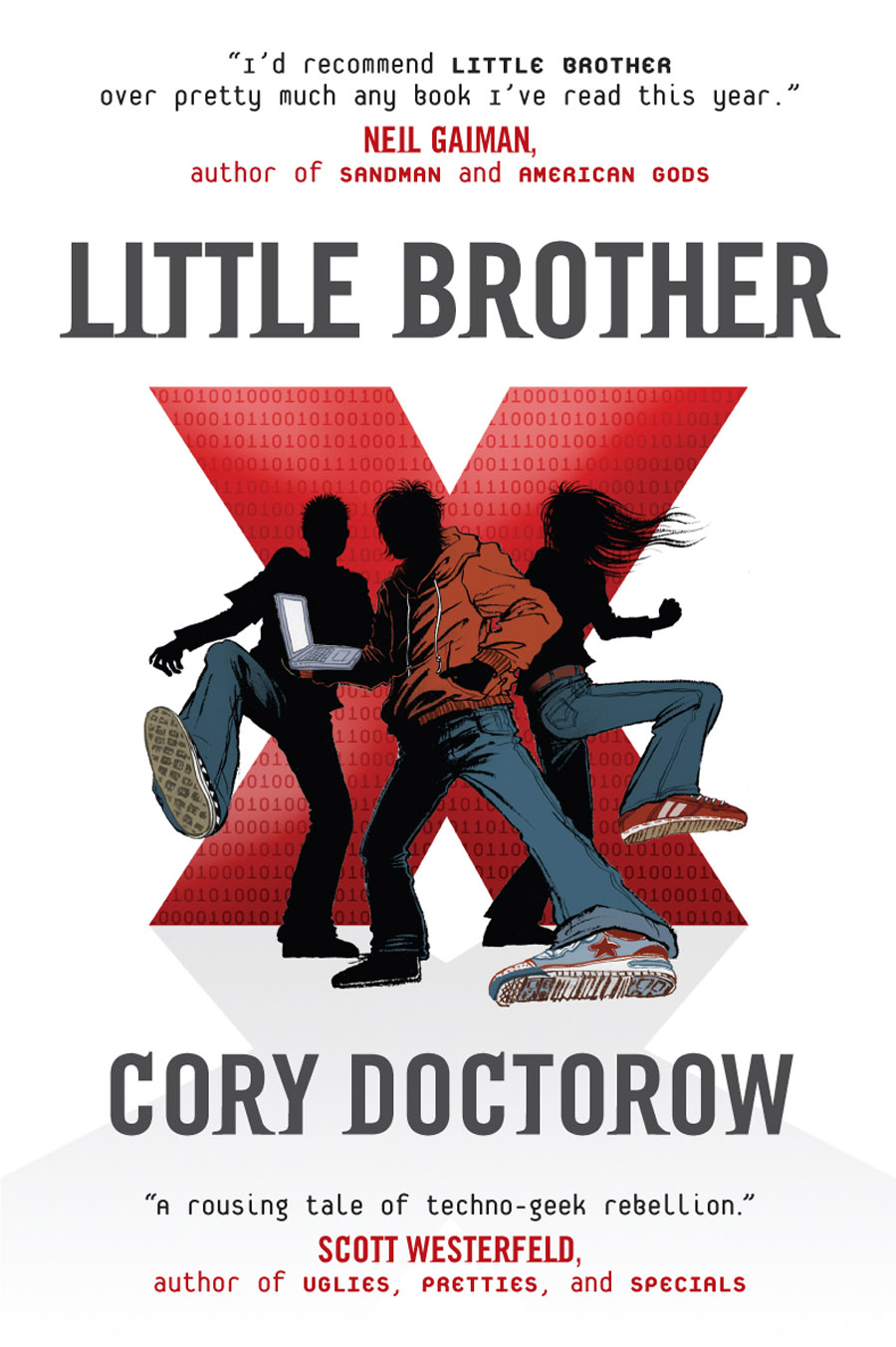
Little Brother

Cory Doctorow's LITTLE BROTHER is getting all the rumpus in the science fiction world lately. SciFi Signal loved it, John Scalzi loved it, Neil Gaiman loved it, and so on. I don't know that I can say that I loved it, but LITTLE BROTHER did drag me along for an excellent ride...and got me thinking too.

LITTLE BROTHER is not a science fiction per se - it reads more like a thriller novel in a very near-future world. Young Marcus is playing a game when he gets embroiled in the response to a terrorist attack. Marcus and his friends rebel against the harsh tactics that the government takes in response to the attacks. Clearly Doctorow is not a fan of the PATRIOT Act nor the government that would enforce such laws. But he does make some very lucid points. Most importantly that restrictions on freedom in the name of security do not make us more free and that any system can be penetrated or bypassed with the right focus and effort.

LITTLE BROTHER is probably more important for these points than the story. We all need to look at what is important and what can really protect us. If we want to be Singapore with all of its restrictions and impositions on personal freedom, then we need to acknowledge the fact and move on. If not, if we value our liberties, then we need to protect them and fight those who would impose upon them.

However, I will see how vulnerable my bike locks are to a bic pen and see what I can do to keep my information safe. Good work, Mr. Doctorow.

Now it's onto Max Allan Collins' STRIP FOR MURDER.

Labels: , , , , , ,