Saturday, September 26, 2009

Mourn the Living

I am so far behind on writing these little reviews that I almost forgot about MOURN THE LIVING. This is a short novel from Max Allan Collins that he originally wrote in the 1960s, but let languish because it never really measured up. According to the author, this was his first shot at writing a novel and it shows. The writing is not as tight as later efforts and the plot is definitely dated in its references – small town colleges, drugs and hippies, but none of this takes away from that frisson gained from reading a Max Allan Collins original.

I have not delved into the Nolan stories that were a hallmark of Collins’ early days (I also haven’t read the Mallory books), but I can see the influence of Richard Stark (Donald Westlake) and Mickey Spillane on the style and pacing. Nolan, a fugitive from and enemy to the mob, is called in to solve the death of a connected friend’s daughter. In doing so, Nolan has to expose himself to those from whom he has concealed himself all these years. This is gritty, fun stuff. I am woefully behind on my Collins reading – I bought this book in England five years ago and am just now getting to it (and I borrowed this copy from the library to boot.)

Reading Max Allan Collins is always a bright point of my day when I can get to it. I hope I can carve out time to read the latest Quarry novels soon.

Labels: , , ,

Thursday, September 24, 2009

Butcher's Dozen


I recently checked out NEMESIS: THE FINAL CASE OF ELIOT NESS and decided to do a whole comparison and contrast between the three novels about the Cleveland Torso Killer. NEMESIS is the most recent addition. Max Allan Collins’ BUTHCER’S DOZEN was the first and Brian Michael Bendis’ TORSO is the graphic novel exploration. Outside of Jack the Ripper, I don’t think there have been so many fictional depictions of a serial murderer. I can only think of two novels about Herman Mudgett and his murder castle and only pieces of Ed Gein’s story appear in various stories. Perhaps it is the unsolved nature of this case that lends itself to literary speculation.

Still I thought it best to start at the beginning with BUTCHER’S DOZEN. This was the second novel in what was then Max Allan Collins’ trilogy about Ness’ time in Cleveland. Collins published a fourth book in 1993, five years after the third book came out.

After Ness left Chicago, he worked in various federal law enforcement positions until he became Public Safety Director in Cleveland in 1935. Collins’ books focus on this period. While in Cleveland, Ness worked tirelessly to clean up corruption and to institute safety measures, such as traffic lights, in the city. In the midst of these efforts, a killer stalked the dregs of humanity who centered around Kingsbury Run – a Hooverville on the lakefront. At least 13 victims were found in various states of preservation and dismemberment. Only two have been definitively identified. The killer was never caught, although speculation lies heavily on one individual. Ness was not the primary detective on the case – after all he was the Director of Public Safety – but he was involved and informed on developments. His most famous action in the case was to roust the inhabitants from the shantytown and then to burn it down.

Collins’ take on these events reads in his normal style – a little bit gritty and fast-paced. He fictionalizes many of the key figures and includes more purely fictional details and characters. Ness isn’t afraid to get dirty or to personally involve himself in the case, but others act as his team on the street. Collins’ killer is related to a key figure in the book, but is clearly not the historical suspect. His killer is more of a sexual sadist than the other books and his Ness is more on the front lines of the investigation.

The book moves fast and covers a lot of ground. It is very entertaining, but not as historically accurate as it could be. But Collins does get credit as being the first author to note the disturbing postcards that the suspected killer sent to Ness over the years, including after his commitment. This fact is referenced again in Collins’ ANGEL IN BLACK, his novel about the Black Dahlia killing, along with some speculation about the Mad Butcher of Kingsbury Run’s suspected involvement in that case.

Labels: , , , ,

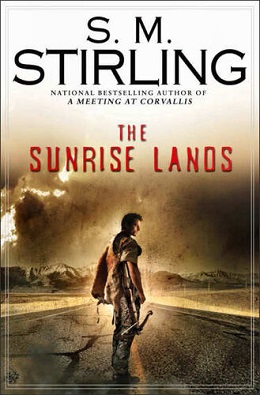
The Sunrise Lands

THE SUNRISE LANDS is S.M. Stirling's continuation of his "Dies the Fire" series (known online as the Emberverse). The original books were a sort of spin-off from his "Nantucket" series whereby Nantucket and the surrounding waters get pulled three thousand years into the past. The effects of this are that technology based on electrical, chemical and nuclear reactions no longer work. Society is changed back to a mechanical technological state and people must survive without the modern comforts of today.

The three books surrounding DIES THE FIRE depict the fall and rebuilding of society in Oregon and Washington State. THE SUNRISE LANDS pick up about 20 years after the final book in that series. Our heroes are aged and their children are now the protagonists - particularly Rudi, son of Mike Havel and Juniper MacKenzie - leaders of the Bearkillers and Clan MacKenzie respectively. The book depicts how society has evolved and begins to give more clues about the Change.

I started this book knowing that three books in the series were on the street and figured I would power through the entire series. However, I found out there is a fourth book due and so put off the rest after finishing this one. More and more, I prefer to read a series as a whole novel rather than as a serialized product.

That is not to say this was a bad book. I enjoyed it immensely. The reader is updated on familiar characters while being introduced to new heroes. Additionally, Stirling begins to fill in what has happened elsewhere and how people have survived. And the book promises a solution to the Change. I look forward to reading the rest following the release of the fourth book.

Labels: , , ,

The Graveyard Book


There are so many things I want to share with my daughter: Doctor Who, Shaun of the Dead, Universal Monsters, The Muppet Show, Carl Barks, Usagi Yojimbo, and now THE GRAVEYARD BOOK. What can I add to the many voices on this fantastic book? Not much, I'm afraid.

I "read" Neil Gaiman's multiple award winning book in audio form. Mr. Gaiman reads the unabridged version and does so wonderfully. So few authors perform their own materials. I can only think of a handful off hand (Max Allan Collins, Harlan Ellison, Stephen King) and they can sometimes be a mixed bag (except Ellison who is always wonderful). Gaiman breathes life into the voices and makes each distinct without taking away from the story. I can still hear Mr. Owens' voice in my head and love to try and imitate it.

The story is simple enough - a boy is orphaned and raised by the inhabitants of a graveyard. He meets friends and enemies, is educated, does battle, and finally grows up and leaves home. Gaiman wrote this as a modern take on THE JUNGLE BOOK by Rudyard Kipling and does an admirable job.

I can think of no better young person's book in the last few years, and I sample many to prepare myself for my daughter's reading future. Only four more years until I can share this great book with my little one.

Labels: , , , , , ,

Monday, September 14, 2009

Dune

There has been a lot of discussion of DUNE going around the web lately. Most of it seems to stem from the theory that the reader should read the first novel and then stop. The purists proclaim that the sequels and prequels are junk that muddies the original's beauty. I have never read the Frank Herbert-penned sequels and have no real intention of reading those books written by his son - not that I have anything against his stories, I just don't have that much interest in them.

I can understand the argument by those who say DUNE is perfect on its own. The story is a masterpiece of worldbuilding. The story is simple enough - a young man takes revenge for his father's murder. But the genius is in everything built around the story. The characters, the creatures, the organizations, the devices - all of it blends into a rich melange of science fantasy. From the beginning on Caladan to the ending on Arrakis, the book is a seamless introduction to the universe of Paul Muad'Dib and to his rise.

Just one reading of DUNE opens the imagination to this world. The reader sees the flapping of the 'thopters, the blue within blue eyes, the ever-present sand; smells the unwashed bodies of the Fremen, the lingering scent of spice; hears the roar of the sandworm, the hum of shields, tastes the spice coffee and so on. The reader can very well see inhabiting these worlds.

There's a reason this is one of the three books I recommend to people who don't read science fiction and that's because it can be a good, engrossing read that explains itself as it goes.

That said, I decided it was time to read DUNE again, but this time with my ears. The audiobook of DUNE is a strange creature. It alternates between a full-cast audio with sound effects and background music and a single narrator. When this change occurred, I was baffled by it. I had to go back and ensure that this was supposed to be the case. I liked both interpretations, although some of the full-cast section sounded like they were speaking through a box - isolated from the rest of the cast. I think I like the narrator (Simon Vance) best because it seemed to be a better interpretation. If his reading could have been combined with the background sounds, it would have been perfect.

The audiobook worked well because this is a well-constructed story. A clear story line is necessary for audio and DUNE is free of strange interludes and time shifts.

I think I'd reserve recommending this audiobook only for people who have read the book. My past reading probably made it much easier to follow - especially with the voice changes.

Labels: , , , , , ,

The Tomorrow Code

With some few exceptions, most of my reading list comes from either John Scalzi's Whatever or SF Signal. This book comes from the latter.

The premise is simple - two teens in New Zealand think of a way to get messages from the future and then start finding them. Of course, the paradox is that their future selves are the ones sending the messages. The idea behind this seems sound enough to answer Scalzi's two question test - why did they find it first? Because no one else was looking for it; how did they do it? By analyzing the data in a different way.

The story is a little heavy-handed in its message - people do bad things to the environment, but that is not anything new. I did like that our heroes couldn't necessarily figure out everything their future selves were saying and that they didn't always succeed. The story was both pessimistic and yet optimistic in the execution.

This was a good science fiction novel, but not as great as some of the other YA literature being put out there. I would give it to a young teen to read, but not an older or more sophisticated reader.

Labels: , , ,